Notes & Insights / AI & Agriculture
17 Sep 2026 · 4 min read
AI in Agriculture: What Will the EU AI Act Change?
Artificial intelligence is entering agriculture through tools for planning, crop monitoring, decision support and automation. The EU AI Act adds a new question to this process: not only what AI can do, but how it should be used responsibly.
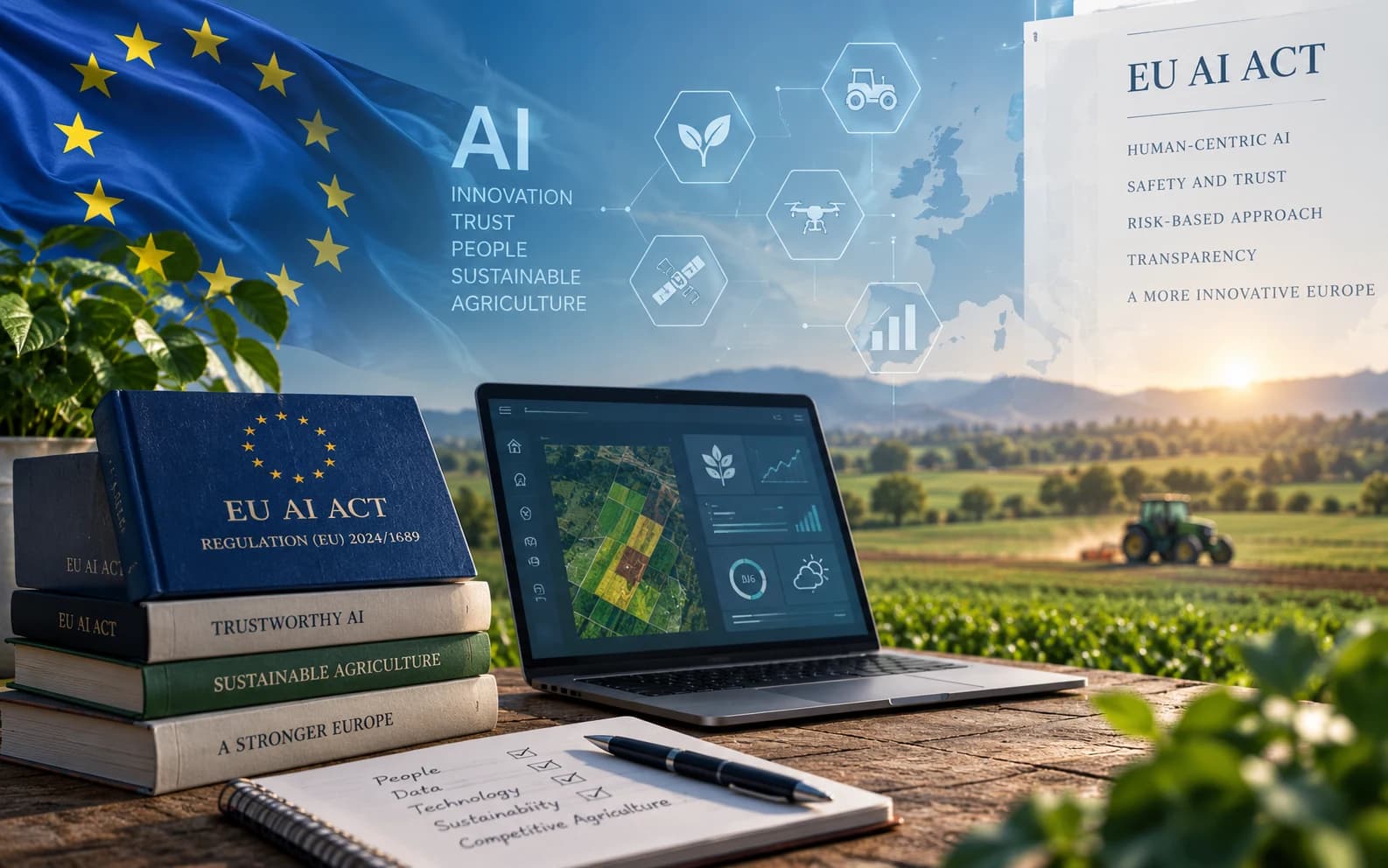
Artificial intelligence is gradually becoming part of modern agriculture. Farmers and agricultural businesses can already use AI to analyse data, support crop management, identify plant diseases, optimise inputs, interpret satellite imagery or assist with everyday planning.
For smaller farms, the most important change may not come from autonomous machinery or sophisticated robotics. It may come from much simpler applications: software that helps analyse information and supports better decisions.
This creates considerable opportunities, but also new responsibilities.
Not every agricultural AI system is high-risk
One important misconception should be avoided: the use of artificial intelligence in agriculture does not automatically make a system high-risk under the EU AI Act.
The regulatory treatment depends on what the AI system is designed to do, the context in which it is used and whether it falls within one of the regulated high-risk categories.
A simple tool assisting a farmer with planning or analysing agronomic information therefore raises a very different regulatory question from an AI system performing a safety-critical function in regulated machinery.
This distinction matters because agriculture will probably adopt AI through many different types of systems rather than through a single category of “agricultural AI”.
Regulation may change how agricultural software is designed
The EU AI Act could influence agricultural digitalisation before many farmers even think about regulation.
Software developers will increasingly need to consider questions such as:
- What exactly does the AI system do?
- Who remains responsible for the final decision?
- What information should be provided to the user?
- How reliable is the output?
- Can the operation of the system be documented?
- What happens when the AI produces an incorrect recommendation?
These are regulatory questions, but they are also good product-design questions.
For agriculture, where decisions can affect production costs, yields and the use of inputs, understanding the limitations of an AI recommendation may be just as important as the recommendation itself.
A possible challenge for smaller farms
There is also an economic dimension.
If compliance significantly increases the cost of developing and operating AI solutions, sophisticated systems may become less accessible to micro and small agricultural enterprises.
At the same time, clearer rules can increase trust and encourage adoption when farmers understand what a system does, what data it uses and where human judgement remains necessary.
The challenge is therefore to avoid a situation in which responsible AI becomes synonymous with expensive AI.
Europe needs both trustworthy systems and digital solutions that smaller businesses can realistically adopt.
From automation to decision support
For many farms, the near-term value of AI may lie less in replacing human decisions and more in supporting them.
An agronomist or farmer could use AI to compare alternatives, analyse historical information, identify unusual patterns or prepare a preliminary recommendation. The technology provides additional information, while the person remains responsible for interpreting it in the context of the farm.
This model may prove particularly relevant to smaller agricultural enterprises because it allows AI capabilities to be introduced gradually rather than requiring complete technological transformation.
The real question
The EU AI Act should not end the discussion about AI adoption in agriculture. It changes the questions we need to ask.
Instead of simply asking:
“Can we use AI here?”
agricultural businesses and technology developers will increasingly need to ask:
“What value does AI create here, what risks does it introduce, and how should people remain involved in the decision?”
For European agriculture, successful AI adoption will depend not only on more powerful technology.
It will depend on making that technology useful, understandable, trustworthy and economically accessible.