Notes & Insights / Digital Agriculture
17 Sep 2026 · 4 min read
Digital Agriculture Doesn't Have to Be Expensive
Digital transformation in agriculture is often associated with expensive machinery, sensors and complex software. But for many small farms, the most useful first step may be much simpler — replacing paper, repetitive work and fragmented information with focused digital tools.
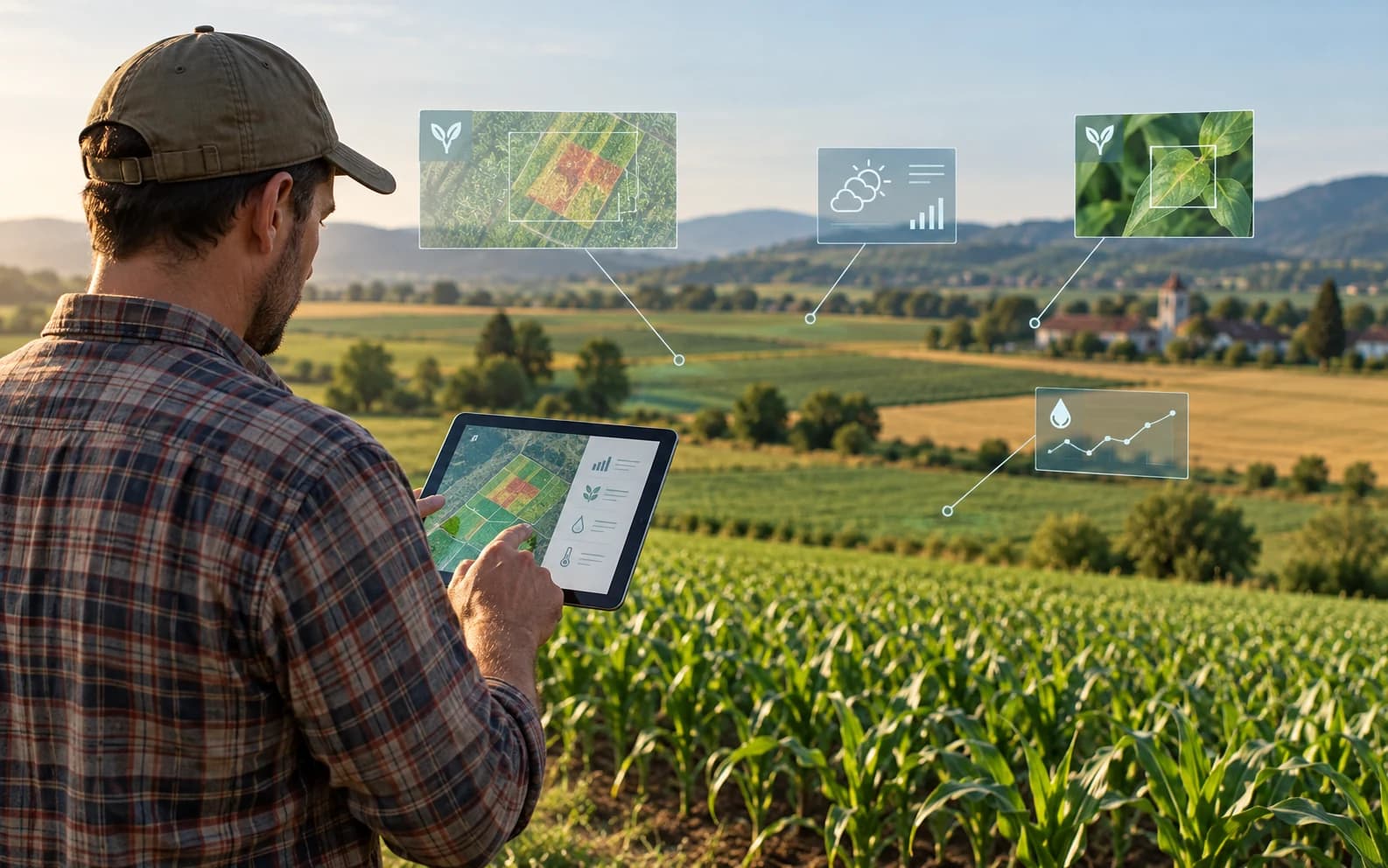
When we talk about digital agriculture, the examples are usually impressive: autonomous machinery, drones, satellite monitoring, IoT sensors, artificial intelligence and sophisticated farm management platforms.
All of these technologies have potential. But they can also create the impression that agricultural digitalisation requires substantial investment.
For many micro and small farms, this is not necessarily the case.
Start with the everyday work
Before asking which advanced technology a farm should adopt, it may be more useful to ask a simpler question:
Which everyday tasks consume time without creating much value?
Planning field operations in a notebook. Writing down inputs on paper. Recalculating quantities and costs. Looking through previous records. Maintaining information in several different files. Entering the same information more than once.
None of these problems requires autonomous machinery to solve.
Sometimes a relatively simple digital tool can already save time and make information easier to use.
Small digital tools can still create value
A digital solution does not have to manage the entire farm.
It can solve one specific problem well.
A simple application might help a farmer:
- plan agricultural operations;
- calculate required inputs;
- estimate costs;
- keep information for different crops or fields in one place;
- reuse information from previous seasons;
- compare planned activities;
- reduce repetitive calculations and data entry.
Individually, these improvements may appear small. Together, however, they can reduce administrative work and create a more structured basis for farm management.
This is particularly relevant for smaller farms, where the cost and complexity of a large software platform may be difficult to justify.
The cheapest technology is not always the best — but neither is the most expensive
The economic question is not simply how much a digital solution costs.
The more useful question is:
Does the value it creates justify the cost, time and effort required to use it?
A sophisticated system with dozens of functions may be an excellent investment for one agricultural enterprise and unnecessary for another.
For a smaller farm, a focused tool that is easy to learn and solves a recurring problem may generate more practical value than a much larger system whose capabilities remain unused.
Digitalisation therefore does not have to begin with the largest possible investment. It can develop gradually as the needs of the farm evolve.
From paper to structured information
One of the simplest opportunities is also one of the least spectacular: replacing notebooks, paper forms and repeated manual calculations.
Paper works. Farmers have used it successfully for generations.
The problem appears when information needs to be found, changed, compared, reused or analysed.
A digital record can become more than a replacement for a sheet of paper. Once information is structured, it can be reused for calculations, planning and future decisions without starting again each time.
This is a small technological change, but potentially an important organisational one.
A practical example
One example of this approach is AgroTechnological Card, a digital solution I have recently explored.
The concept is straightforward: to take a familiar agricultural planning instrument — the technological card — and move the process from notebooks, paper tables and repeated manual calculations into a structured digital environment.
The solution allows agricultural operations, inputs and costs to be planned and organised digitally, reducing some of the repetitive work associated with traditional record keeping.
What I find interesting about this approach is not its technological complexity, but precisely the opposite. It illustrates how digitalisation can begin with a familiar process and improve it without requiring a farm to invest immediately in complex and expensive systems.
For many small farms, this may be the more realistic path towards digital transformation: start with a practical problem, replace unnecessary manual work, and adopt more advanced technologies when they create clear economic value.